
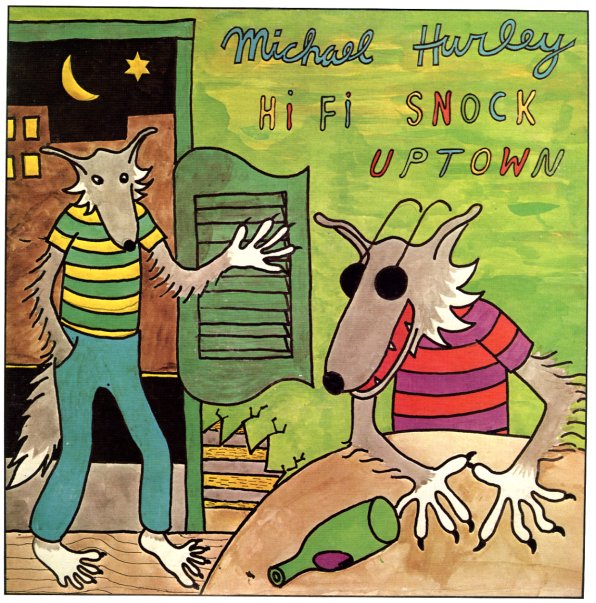
The Vermont saga began with the fact that the theme song of our college radio show, The Sweetwater Jamboree, was a song called Euphoria, done by the Holy Modal Rounders. The Rounders played the old-time music we liked, but with abundant humor and a raucous take on the old songs. But Euphoria was not an old song by the likes of Charlie Poole; it was actually a new song written by some clearly wonderfully demented guys named Hurley and Ramaily.
The Holy Modal Rounders had been a two-man ensemble but they expanded into a larger quasi-rock-psychedelic band. And we heard they were playing in Boston so we went to see them. They were opening for what the stage announcer referred to as “The Mighty Velvet Underground”. (Lou Reed played such a bad pretend guitar solo that I lost all respect for him, permanently, that night.)
But in between bands we ran into one of the original Rounders, either Peter Stampfel or Steve Weber and we told them that their version of Euphoria was our radio show theme song. They said, great, if you want to meet the guys that wrote it they are here tonight. So right there we made the acquaintance of either Michael Hurley or Robin Remaily, or maybe both.
And we started hanging around a bit with Hurley and Ramaily, who were a bit older than us, and pretty well settled into their particular funky Bohemian groove, not hippies, but something more connected to a romantic past than to any sort of flower power future.
By “we” I am referring to myself and to Honest Al, the other half of our Sweetwater Jamboree radio partnership. I went by Sloppy Jon, which was a reasonable nickname for me, and probably has only gotten more accurate over the years. Honest Al was my best friend all through the college years and after and we did some really funny and strange things together, including the Vermont saga.
At some point Hurley and Remaily invited us to come visit them at the Vermont farm that is apparently some kind of group living situation, though we never did find out what kind or who actually lived there. They drew a map for us, this being a full half century before GPS and Google Maps. We picked a weekend and drove up in Honest Al’s newest car, a shiny red Alfa Romeo.
And we found the farmstead as promised, complete with Hurley and Remaily, and gaggle of other guys of similar mindset, and many of their women and wives. The women were very different than the guys: I remember them all gathered in the kitchen wearing all cotton and wool, possibly home made dresses. They seemed dedicated to a lifestyle that avoided the mainstream culture as much as possible. They were all about putting up food, avoiding supermarkets, and probably doing much of what The Whole Earth Catalog was suggesting, though it was never clear that that was their source of inspiration. But we didn’t linger in that deeply female lair for long; we went back outside with “the boys”.
The boys had a somewhat parallel but very different way of avoiding mainstream popular culture: they were all into driving cars from the 30s and 40s. These old cars had “flathead” engines, a type of engine that is nice and simple but its design keeps it from having high compression which limits the power a flathead can generate. (You can hear a positive reference to flatheads in at least one Beach Boys song from their car phase.)
Honest Al’s sexy Alfa did not impress these guys in the least; they would have dug a rusty 38 Dodge much more. They swore by these old cars and relied on the JC Whitney catalogs to get parts. I remember one guy saying that these cars “liked” the back roads and even at the same speed would drive much better and happier on a back road than on an interstate.
In spite of the great fondness for old flathead cars, the whole troop of guys made a pilgrimage over to one of the barns nearby, where there was a gigantic V8 engine and transmission lying on the ground, having been removed from some kind of late 50s or early 60s monster. There was discussion about its displacement and reverence expressed towards its 427 cubic inches. If I had a recording of the conversation in that barn, around that V8 I imagine that I would have the kernel of a great American stage play.
These were very unabashed male dudes; not a bit of hesitance about their love of cars, flathead or V8; there was no question that the women belonged in the kitchen dealing with woman stuff and they belonged out with the cars. We were not around the farm long enough to get a deeper understanding of what was really going on because Honest Al glanced into the back seat of one of the 1930s cars and noticed bright green circuit boards lying there.
He questioned the owner of the car about this odd happenstance: clear signs of computer involvement that seemed out of place in this milieu of “back to the 30s and 40s.” The owner of the car and the circuit boards looked at Honest Al and said, in the countrified accent that all the guys stuck to, “You know about that stuff?”
Honest Al happened to be very deep in that stuff, as an MIT dude, part of the project that grew into The Media Lab, the famous and influential MIT computer project. So Honest Al said that, yes, he did know about that stuff. So then ensued a conversation that veered from flathead 30s cars right into cutting edge computer talk, such as it was in 1972.
Eventually the car and circuit board guy, who was Sid, who worked at Dartmouth, found that it was pretty refreshing to emerge from the guise of a Vermont old-timer and talk computers with a cutting edge MIT guy. So Sid invited us home for dinner, saying that his “arbitrarily good wife” would probably be ok having us surprise her for dinner.
And thus began our Vermont connection with Sid and his arbitrarily good wife, Barb, which requires its own chapter, as we went back often to visit Sid and Barb and their kids, way up on a steep hillside.
We lost contact with Hurley and Remaily after that. But I won’t every forget the night that Hurley took us skinny dipping in Jamaica Pond after midnight, which is illegal, but Hurley didn’t let that get in the way of a religious experience like post-midnight self-baptism.
Hurley and Remaily did not stay together as a songwriting team. Hurley spent the rest of his life singing his own very particular songs in music clubs, mostly in the Pacific Northwest. He has many albums of his music. He did wander through Boston from time to time and I would try to connect when he did.
One summer I gave him a radio show on our MIT station where we were doing The Sweetwater Jamboree, which we continued a few years after we graduated. Hurley called his show The Swamp and played all the kinds of music that he loved. And when he got hold of my LP of old Riley Puckett songs he borrowed it and eventually handed it back with the inscription on the cover,”This record is a brick shithouse.” Which, in case you don’t know the expression, is the very highest form of praise.
Hurley passed away recently which is probably why this story emerged entirely ahead of the chronology that I had been working from. He was a very sweet man who just wanted to sing songs and sip a few beers. He didn’t like marijuana; he said it pulled things apart whereas alcohol brought things together.