
This is a very difficult story to tell because to many people it will make no sense at all. And yet it explains so well what our family was about; the odd ways they dealt with being Jewish in a Christian small town. Or rather how not to be Jewish.
To start with, my parents had forcefully abandoned all religious aspects of being Jewish: none of us three boys were bar-mitzvahed, we didn’t light candles on Friday nights, we never celebrated any of the Jewish holidays, they never even came up for discussion.
The other branches of the family, my uncles and aunts, all did these things, so the only greater family dinners we had were Thanksgiving, a purely American holiday that was good for everyone. We did go to our cousin’s bar mitzvahs and we thought they were strange rituals; we were glad that we did not have them ourselves.
I think that my parents active dismissal of all religious Judaism came from two sources: one was the tendency of some immigrants to want to abandon all trappings of the old world and become as American as possible. I think my parents saw the Jewish rituals as stuck in backward, European, old-fashioned thinking.
And the other source was their far-left politics. It is known that Marx said that religion is the opium of the people, a balm that allows people to accept whatever degradation that upper classes and bosses deal out. I think that between these various influences, my parents arrived at a mindset where nearly any religious activity seemed absurd, mindless. They felt that only science and education led to enlightenment, not reading endless verses from a book.
And beyond all that, I was the third and last child. By the time I was old enough for a discussion of Jewishness, they had lost interest and motivation in that direction.
So, to become More Fully American, we always had a Christmas tree and presents on Christmas morning. The holiday was about presents, like a birthday party, with absolutely no religious trappings at all. So I could go back to school after Christmas break and write my little essay about what I got for Christmas.
There were, in fact, perhaps 4 other Jewish kids out of about 80 in my grade school class. I suspect that at home they practiced much more Jewish religion, but I never spoke to them about it or saw it up close.
So here we are, a culturally Jewish family with no cultural awareness, particularly none for me. My mother and I would make Christmas cards and send them out. Perhaps we might say Season’s Greetings, but not always. And I also remember my mother and I dying Easter eggs. Which I reminded my mother about many years later when she complained that my two brothers were not raising their own children with any Jewish consciousness. So I would remind her of those Christmas trees with electric trains running around them.
We were certainly atheists, though that was never talked about: we just honored science and knowledge; the most honored person was Einstein as being the greatest genius of science.
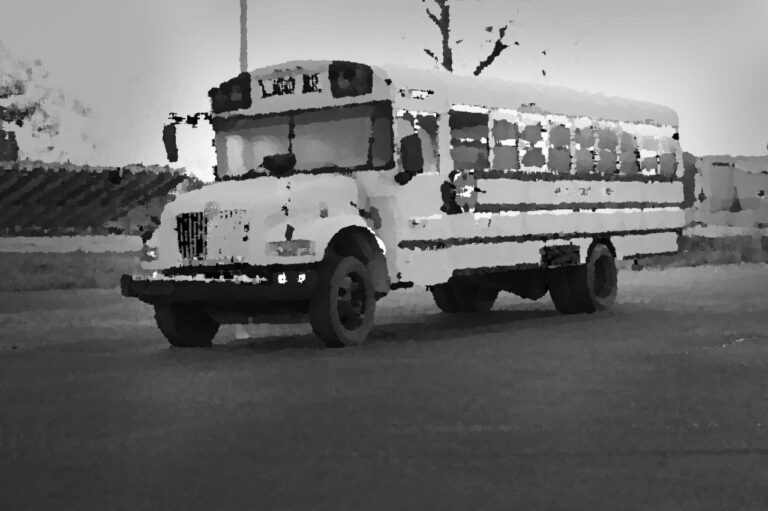
So here I am riding the school bus with my buddies every day. And part of our bus trip involved dropping off the kids that went to the Catholic School. (We picked them up and dropped them at their own school, no idea how they got home.)
And because they were different we hated them and talked against them. They wore blue uniforms to school which we thought looked stupid. We said they fought dirty and would spit a lot.
The next part is difficult to tell because it is so entirely absurd. But it is true.
While we were sitting there saying nasty things about the Parochial school kids and just reveling in our bonding – via hatred of others – my buddy added another layer, saying…
“Fuck you, dirty Jew.”
He was not saying it to me. Never occurred to him that I was a Jew. And never occurred to me, either. Why would it? It was never talked about at home, at least not in any direct way.
I was impressed with the “poem” that my buddy had recited and told my middle brother about it. He, being three years older and much less clueless, said, “That’s not funny. We’re Jewish”.
It gets even stranger.
Not thinking for a moment that my buddy could be different from me, I told him the same thing my brother told me, “we’re Jewish.” Meaning that my buddy and me and some larger ill defined group must all be Jewish. How could I be different from all my peers, buddies?
So my buddy goes and tells HIS older brother what Jonnie Sachs said and his brother enlightens him that those Sachs people, they are Jews, but we are certainly not.
And the next day I get on the bus and become Instant Jew.
The kids are saying various anti-Semitic things, the one I remember is “Why didn’t Hitler get you, too?”
This is right after World War 2 when hatred for Nazi Germany was very fresh. But the hatred for Jews trumped the anti-Nazi sentiment.
It was quite upsetting so I went and told my parents what had taken place. I didn’t tell the whole story of the gaping ignorance that they foisted on me, just the part about the bad scene on the school bus.
They went and paid a visit to the parents of the ringleader kids. I remember my parents being surprised that such a thing would come from a family that were Christian Scientists, themselves a bit apart from the mainstream.
But life went on, pretty much back to the way it had been. I was still kind of one of the kids. Never had another direct or even indirect anti-Semitic incident. My differences from many other kids were not because I was a Jew. The differences were social and political. My brothers and I were college-bound, not all kids were. We were better students than most. So I was able to remain friends with some of the more mainstream kids by being careful not to rub in their faces the differences between us. My parents had not graduated from college, but my father was a white-collar worker, a magazine editor. Many kids had blue collar worker dads.
What is also very strange is that – to the best of my memory – my parents never sat me down after this ugly incident to explain what it meant to be Jewish. I suspect that doing so would have meant owning up to the hypocrisy of having a Christmas tree, and so forth. Instead they just let it drift away.
There is a related tale about Jewishness in Mahopac. Many of the large houses around the lake were owned by wealthy Jewish people from New York. And some of these people were very upset about paying higher taxes for schools for the local yokels. At one school meeting – that my mother loved to tell me about – a woman got up and said there was no reason to waste money on educating Mahopac kids because they would all just work in a gas station anyway. And my father got up and said that that was simply not true, and anyway, without education how could a kid get a better job anyway? My mother always said that that little speech by my father made him very much liked and respected in town. But my father was never further involved with town politics in any way. There was a local wealthy Jewish man who was very vocal in his opposition to school spending, got on the school committee, and my father hated that man so deeply that he could not safely be in the same room.
There is a common expression among Jews who feel that other Jews don’t support Israel and Judaism enough: self-hating Jews. Jews who buy the hatred aimed at them. But there are also some Jews who do things like fighting against educating the locals that cause both gentiles and certain other Jews to hate them. And it is too easy to connect your hatred of a person to their ethnic identity. It should be added that the beloved doctor, Doctor Jacobs, was a Mahopac Jew who was loved by everyone, including my father who cried like a baby all night when Matty Jacobs died.
This is a messy story of family that didn’t embrace Judaism, didn’t deal with it in any constructive way. I assume that American families that did maintain strong Jewish culture with holidays and so forth may look at our family almost with pity for having given up so much. But in fact, though I am well aware of the void in my life from the removal of Jewish awareness, I am also very thankful for the freedom of thought that comes from not being brought up that way. It is kind of like how I am so glad that they moved us to this beautiful farm even though it was also lonely and isolated. I would not trade either part of my upbringing.