
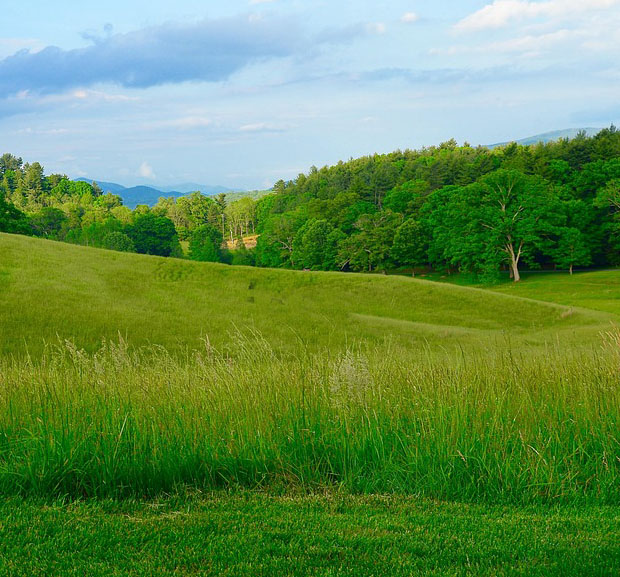
The house and the barn were surrounded by the fields. And each field had its own personality, each had its stories.
The Field Below the House was just that, sitting well below our back lawn, down a cliff of 20 foot rock. It was the field we would look over towards the distant hills, southeast of us.
The field had been slipping back to forest so Dad and Fred cut down the larger trees. Then they connected the spinning belt pulley wheel of the John Deere to an old buzz saw using a 30 foot long leather belt. That saw had a very frightening 3 foot spinning blade with which they would try to cut up the trees. That was scary to watch, that spinning, rusty three foot blade, and I suspect my mother may have forbidden any more use of that setup.
There was one giant sugar maple that they didn’t cut down. It had a perfect shape and in every season it was the king of the Field Below the House: celebrating in springtime, rich and full in summer, heart-stopping in fall, and then in winter it would occasionally be decorated by an ice storm, a magnificent sight.
Later on I tried tapping the sugar maples in late winter and that grand tree was the most valued source of sap.
Brother Fred had also cleared out dozens of smaller trees by girdling them and they became a array of dead three foot stalks in the lower section of the field.
One winter day I was sledding down the upper part of the Field Below the House, which had a nice slope to it, and had no trees at all. I was sledding, if that word applies, using a diabolical device called a saucer. It was a three foot aluminum dish with rope handles to hold onto. But there was no way to steer; you just held on and hoped. So one time I was flying down the hill, spinning and sliding and I slammed into one of the dead stumps. I hit my head incredibly hard, right above my ear. I was scared that I was seriously hurt, but staggered back up to the house, dragging the saucer. I suspected that my hearing was damaged from that smack, maybe permanently.
Later, my friend Maynard and I took wooden clubs and banged over all the remaining stumps, with great energy, shouting “Gala-poochie Pup!” as we clobbered them. I can not bring back the origin of Galapoochie Pup, but it seemed like the right battle cry in our war with the stumps.
The Field Below the House was also where big brother Fred went to launch one of his home made rockets and he let me tag along. He put the rocket on a rusty v-shaped metal bar, lodged between two small saplings, lit the fuse, then we ran and hid a ways away. The rocket started sliding up the v-shaped guide, but then exploded right between the saplings. My memory, perhaps questionable, is that both saplings were blown apart and from the metal launch bar upward, both stuck out sideways at right angles. I don’t remember other rocket adventures with Fred so either he called it quits after that, or maybe just never brought me along again.
There was a well in that field, three feel wide and deep enough to drown in, with green algae and frogs. I never did fall in, though I came close a few times.
Based on the water-holding ability of that well my parents decided to try building a pond in that field. They hired a fellow to come and dig some test holes. But he concluded that the soil would not hold water without a concrete lining, which was going to cost too much. So we never had a pond, and had to make do with building dams in the stream.
At the very bottom of the Field Below the House there was a stone wall that separated it from the woodlot, which was what we called the forest past the wall. And we treated that as our junkyard, throwing away old bed springs, torn up useless chunks of wood and plaster, and who knows what else. That dumping spot was – mildly – a source of shame to me.
One time I got a big plastic boomerang as a present and Maynard and I took turns standing on the rock at the edge of the lawn looking over that field and throwing it. Maynard was bigger and stronger and his throws went sailing way out over the big field, high in the air, even above the great maple tree, before sailing back towards us.
The Field Below the House is also where the 37 Chevy landed after it slid down the driveway, over the lawn, down the tumbled-down stone wall, and came to rest against a tree, near the spot where we had exploded the rocket. Fred and Dad towed the 37 Chevy back toward the house, but only got as far as the Lower Barn Field.
To get from the Field Below the House to that next field, the Lower Barn Field, you had to pass through an opening in the stone wall between the fields. That gap in the wall was where I watched our butcher slaughter the pig.
The Lower Barn Field was not very big, and along with the 37 Chevy was home to the place where our sewage water leaked out. That area was always very rich and green. You could only get away with draining sewage into a field way way out in the country where the next house was nearly a half mile away.
There was a big, lovely tulip tree that grew in the Lower Barn Field. And nearby, on summer nights, the whip-poor-wills would call out, a sound I have not heard since I left that farm and a sound that would bring me right back there.
Fred built a rough shed at the top of the Lower Barn Field, just below the parking area outside the barn. This was where the cow would hang out and where I would go feed it a coffee can full of corn every night.
There was just enough grass in the fields below the house and barn for Fred to cut, rake, and build a haystack. And just before dinner one night my father took me down there and tossed me into the haystack where I would slide back down. It was fun and we did this until we disturbed a nest of yellow jackets in the hay who stung both of us badly. I got stung often enough by bees ands wasps, but I have always said that yellow jacket stings are the worst.
At the very top of the Lower Barn Field was the Chicken House, a rickety wooden building filled with old paint cans and vast numbers of wasps. You tried to go in there only during winter when the wasps were all gone.
There actually was another field, above the Lower Barn Field, but it was full of little sumac trees and we hardly went up there. Once I took an old ski pole and went up there and had a massive duel with the sumac, smashing and slashing it with my ski pole weapon, feeling like a brave knight.
The Barn Field was the star of the show, a big open field full of lush grasses where the animals must have grazed with great joy.
It was also the field where we would set up old dishes and paint cans, from the chicken house, for target practice, placing them on the ancient apple tree at the top of the field. Past the trees the hill rose up quickly, forming a safe backdrop for shooting.
Our only gun was a 22 with a six shot clip. But our friends who owned a hardware store in Westchester would come up with serious guns: 30-30s, and such. The shell of a 22 is a quarter inch tube, about a half inch long, The shells of their rifles were two or three inches long, with fat half-inch barrels that narrowed down to lead that was probably twice the diameter of our 22s.
Later on, I hoped that neighbors would hear the roar of those bigger guns and conclude that our family was perhaps not one to mess with. This was after I learned about World War Two and Nazis and Germans, and connected those thoughts with the rather German rod and gun club not far away, perhaps just within the sound of rifle shots.
The Barn Field was where I drove the green Chrysler that my parents gave me to play with when it was no longer safe to drive on roads. I drove it around the edge of the Barn Field, nearly wearing down the grass into a dirt track and almost turning that old car over on the downhill turn. I used to ponder how cool car-kids from California could take an old car, chop it down with welding torches and make it into a buggy. That kind of thing was utterly beyond me.
The barn field was also where the herds of deer would gather, leading to the massively embarrassing episode that I reveal in another essay.
And it was largely in the rich and productive Barn Field that I continued the holy ritual of cutting and raking the fields – long after the animals were gone. I did this because Fred had done it, so clearly it had to be done. It was part of being on the farm. Fred had cut the fields and then pulled the old iron rake over the cut grass, first raking it into windrows, then raking the windrows into small haystacks, with me riding on the rickety rake, with its scary, long, curved teeth. When i took over this task there was no younger brother to sit on the hayrake and stomp on the pedal at the right moment to raise the teeth to dump the hay. So I recruited Bobby O’Hara, the younger brother of a classmate. We raked those fields so as to keep the fields clear and to continue the myth of our family farm. We both remember those raking sessions fondly, even though it was essentially pointless.
Cutting hay with a sickle bar is a wonderful task to behold. When the grass is tall the teeth of the sickle bar chop it off near the ground and the grass shudders and then falls neatly behind the bar. The smell of cut hay is different from the smell of cut grass on a lawn, but just as rich and wondrous.
Across the driveway from our house was The Garden Field, where we had our world-class gardens. But the field was much larger than just the garden and it yielded lots of hay. The very bottom of the field led down toward the bottom of the driveway. It was very steep, and you could get in trouble with the tractor down there. But that area also had a great growth of ferns, so when you cut that part of the field with the sickle bar, the smell was particularly intoxicating.
At the very very lowest corner of the Garden Field among the ferns, it was decided to plant a tree, and little Jonnie was allowed to choose the species and I chose a red maple, which we bought and planted. It might still be there, but I can’t go back to see and take the risk of seeing our dirt road paved, our fields grown over, and the barn knocked down.
There was another gate in a stone wall between The Garden Field and the next field, the Brook Field. This was the field that ended at the brook and the swamp. It was not very big, but Fred fenced it in with electric fence, along with most of the other fields. You could get into this field right from Mexico Lane, which made it easy for the next owner of the farm to sell the Garden Field where another house was built.
My friend and I planted some marijuana in the upper corner of The Brook Field, but it never grew into anything much, though I did pull it out and tried to smoke it.
There was another odd little field above the Brook Field which was called… the Upper Brook Field. It was small, half overgrown, and had a curious feeling of being at the edge of civilization. I would only go there when I wanted to be where nobody would ever look for me.
Those six fields were a potent presence in my childhood. I can still see each one, vividly, in any season, from any vantage point.
And all of those fields are gone; mostly grown back into forest. I was upset when I realized the man who bought the place from my mother was not mowing the fields, letting them to go back to shrubs and forest. It hurt me to see.
Which is odd, because before Europeans came and cut the forests down, this area was all forest. But I have a silly romantic feeling about farm fields, tied deeply to my childhood. I took over, for a while, management of a park near me in sub-urban Boston because it had fields, fields of hay and wildflowers where I could, and still can, walk around like that unfettered little boy.