
I saw a bunch of therapists during my difficult thirties. I was divorced, my business was a constant source of stress, and life was a drag.
Some therapists are good, some not. The guy who fell asleep on me was not good, though my depression was probably thick enough to drive anyone to escape by any means available.
But there was one therapist named Sarah that asked me The Most Important Question. A question that nobody had ever asked me, therapist or friend. She asked, “What was the mood in your house when you were growing up?”
Because, she said, little children know and tune into the mood even before they can talk. Which in retrospect is obvious; even the family dog knows the mood in the house.
The answer to this question was obvious, right away: the mood was depressed, not light and happy, but heavy and somewhat somber.
And Sarah said “find out why and that will go along way to helping you.” It didn’t take more than a few seconds to figure out the Why.
I was born in July 1949 and in February of 1950 Senator Joe McCarthy gave the speech that made him a national figure and started the terrible period known as McCarthyism in which many careers were destroyed by his obsession with Communists loose in the US.
My parents, seeing the devastation and poverty during the depression, concluded that capitalism as it was being practiced was not working. So they had more than a little involvement in one flavor of the far left in America. I don’t know much about that era in their lives because it was never talked about, and in the end they were just old left Democrats who spoke of FDR with great reverence.
But in the early 1950s anyone with a hint of Communist connection was in potentially big trouble. I have since thought that there were two approaches that people took to deal with this: one was to continue to march and speak out bravely against McCarthy and his ilk; the other was to go quiet and essentially hide from the fuss as much as possible.
The latter is what my parents did, and moving the to farm in Mahopac was, I think, part of that going quiet. We moved from Croton-on-Hudson, which had been a center of left wing activism for decades.
So with me still a drooling baby, my parents reading the headlines and living in… what I now view as fear and shame. Fear of the FBI driving up in a big brown car and taking them away. Shame because they just hunkered down and hoped, not sticking up for others who were taken away.
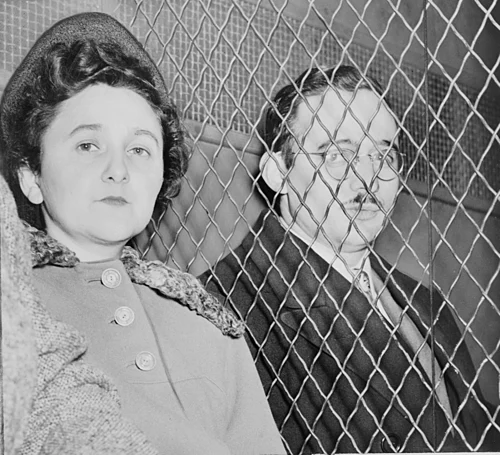
And the Rosenbergs were executed for spying for Russia on June 19, 1953, just a month before I turned four. While my parents were certainly not spies for Russia (assuming that the Rosenbergs actually were) but they were another Jewish American left wing couple with little kids, who as a couple were taken away, put on trial, and sent to the electric chair.
So the specter of family annihilation by the FBI seemed very real. Hence, from my being about 6 months old in 1949, until McCarthy fell from power in 1954 our household was stewing in fear all the time.
Certainly there were happy moments, with Mom reading to us kids, and with birthday parties, and all the normal stuff, there was a heaviness in the air.
And like therapist Sarah pointed out, kids tune into the mood even before they can speak. A kid wants to fit in, and if the mood is depressed, then being happy-go-lucky is not how most kids will adapt. I didn’t.
I remember the evening in May 1957 that my father came home from work and announced that Joe McCarthy had died. (Died at 48 from liver cirrhosis.) My mother said we will have cake for desert. I was 8 years old and jumped on the idea that we needed to celebrate a bad guy’s death, though I had no idea who he was at that time. I asked if we could have ice cream on the cake and my mother felt forced to let me know that after all someone did die and we could not really celebrate. I imagine she was thinking I would go off to school and brag how we had had cake and ice cream to celebrate the death of that guy Joe. And of course there were probably more than a few people in Mahopac who mourned the passing of McCarthy.
I would like to say that grasping the Most Important Question and the answer turned my depression around but it didn’t, not entirely.
I remained a pretty unhappy guy for a few years longer.
Until I mentioned my depression to the mother of a friend who said in a very offhand way, something like, “Oh, you don’t have to live like that. They have great medicines now.” So I asked a doctor and they said, sure, you can try Prozac. After about two months I recall having a moment of simple, pure pleasure. Joy, in fact. There was a waitress whose eyebrows made perfect half circles above her eyes and this filled me with great joy. Before Prozac took effect any possible reaction of joy would have been overcome by feelings that she was too pretty to be interested in loser like me. But this time it was self-judgement free, just joy at seeing beauty.
And since that time, about 30 years ago, I have been riding above that sea of depression, busy and productive, and truly the happiest time of my life.
And of course there is one more reference to the title of this story, The Most Important Question. And that was when the US Army’s Joseph Welch asked McCarthy in a Senate hearing. “Have you no sense of decency, Sir, at long last? Have you left no sense of decency?” Which many feel was the beginning of McCarthy’s downfall.
And one footnote. McCarthy’s partner in his wave of lies and hatred was Roy Cohn, who was the person who taught Donald Trump how to deal with people through threats, bribery, and blackmail.