
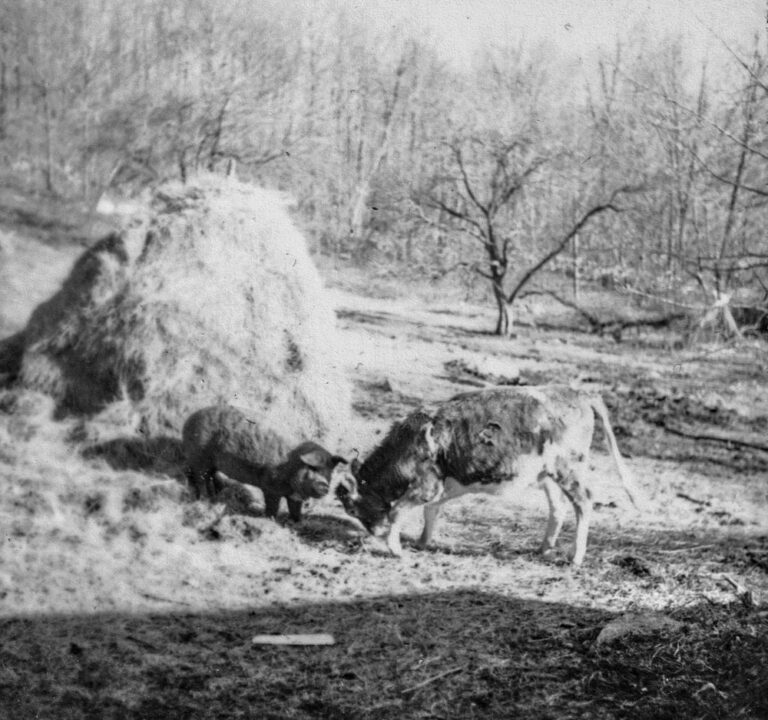
Aside from the fairly short lived experiment with chickens, we had an assortment of other animals over the first few years: a cow named Susie that we bred for calves, two sets of pigs, a pair of goats, occasional horses.
(Plus a parade of cats and dog, which is a whole other topic.)
But the big animals were a big part of life in the early years. One of the first things I remember is that we went and bought a horse named Champ from some folks on the other side of the mountain behind the house. They brought Champ over in a horse trailer since we didn’t have one. Big brother Fred had fenced in the Barn Field, a sizeable field with lots of lovely lush grass. But within a day or two Champ decided this was not working out, jumped the fence and went back home, directly over the mountain top, not on the roads. I still marvel that the horse somehow knew exactly where his real home was and walked there through the wooded hillside. We didn’t try again with Champ; I think we felt so profoundly rejected by this horse that we just let it be.
Years later we boarded two horses from a summer camp that needed a place to live from September till next June. They were Sparky, a big friendly horse, and Bobby, a pretty nasty pony. Summer camp horses are ridden on by assorted kids, some of whom probably should never be around animals.
But I remember sitting in school thinking – My Gosh, Horses! I could not wait to get home. I already knew how to saddle and bridle them, or I thought I did. I would put the saddle on little Bobby, but he was too smart and opinionated and would never open his mouth for the bit of the bridle. So I would bridle up Sparky, who was easy to deal with. But I could not lift Sparky’s saddle up and get it on him, so there I was, with a saddled pony and a bridled horse. After that I only rode when my father was there to get us going. But I do remember that one of Bobby’s tricks was to find a low overhanging tree limb, walk under it, and scrape me off onto the ground.
After those two went back to camp we never again had horses. We had learned that real horse people have their own horse, that summer camp riding can be questionable, and we were not up for the effort and expense to buy more horses, feed them, curry them, and so forth.
I remember a calf that we had that got very sick out in the cold. We brought it into the kitchen where it layer on some hay on the floor, but soon died, while we were playing board games in the living room at the other end of the house.
But we had Susie the Cow, and hence the photo of Susie hanging out with one of our pigs. Herd animals, lacking others of their exact species, formed a two-animal herd between them. They would sometimes break out of the fence together and go for hikes in the woods or on the local roads. We would get calls and have to come and get them, taking the cow by the collar and leading it home, the pig happily following along.
One of big brother Fred’s chores was to milk Susie before school and after. And we had what was probably wonderful, fresh, organic milk. Susie and the whole cow situation was long gone before I was old enough to be handed down milking chores.
There is a particular farm boy memory that is deeply imprinted with me: the day that the vet came to inseminate Susie. The process is complex, but starts with the vet donning a big arm length rubber sleeve and reaching inside the cow through an opening next to the one associated with bearing young. The vet then scooped out lots of cow poop, I supposed to clear his way for the next phase. Then he took a glass syringe that I remember as well over a foot long, and deposited a generous amount of bull semen into Susie. I was probably 5 or 6 years old and found the process extremely educational.
I think it might have taken more than one try for Susie to get knocked up, but she did, with semen from an Angus bull, since the goal was to use the calf for food.
And we did. I have no memory of how the black calf that we called Susie Q turned into packages of meat in our freezer. But I do know that my mother had to grind up most of Susie Q into burgers because her actual recognizable parts didn’t look like store bought meat – we could not avoid knowing we were eating Susie Q.
The farm mentality, where one learns that animals do get slaughtered and eaten, never quite landed with us, and after a few years all of our meat came from the store.
The goats we got were a couple, male and female. My brother Fred, who had become skilled enough at milking Susie, was never able to get the hang of milking Ms. Goat. And Mr. Goat was a tough guy; he would charge people and butt them, mostly me. Eventually my parents got tired of me being bonked around and Mr. Goat was shot with our 22 caliber rifle. We gave away Ms. Goat who we later learned became the New York State champion milk goat.
But the most vivid memory of my farm childhood was when our local butcher came to slaughter one of our pigs. (I seem to recall that our pigs came in pairs, one of the pairs was name Hedda and Louella, but this pig met its end alone.)
The butcher could not catch the pig, which probably sensed trouble and ran away. So the butcher got his rifle, I think it was a 30-30, and shot the pig.
He then put a 50 gallon barrel on some rocks, right in the gap in the stone wall between The Field Below the House and the Field Below the Barn, a kind of pretty spot.
He filled the barrel with water and lit a fire under it. While it heated up, he put together a wooden tripod of sort, about 20 feet tall, then he attached a block and tackle to the top of the tripod.
Then he hoisted up the dead pig and lowered it into the now boiling water. After a while he hoisted it back out and, I suppose, let it cool before removing the pig bristles from the skin.
Then he proceeded to cut it open and the look of the bloody ribs hanging in mid air, with short piggy legs hanging below, is another image that is permanently imprinted in me.
However, unlike the sight of a butchered chicken which put me off chicken for some years, I never stopped eating ham, bacon, and pork chops.
There are just some things that never fit together properly, like mixing pieces from two different jigsaw puzzles. Appreciating a calf, or a pig, or a lamb for it’s wonderful presence and animal nature, does not square with killing it, cutting it up, and eating it.
Which is, I suppose, why in today’s United States almost everyone buys meat at the store, and we never, ever see videos of what takes place in the slaughter houses.
I saw lions take down and eat a wildebeest in Kenya; that is clearly part of nature. But we are not lions