
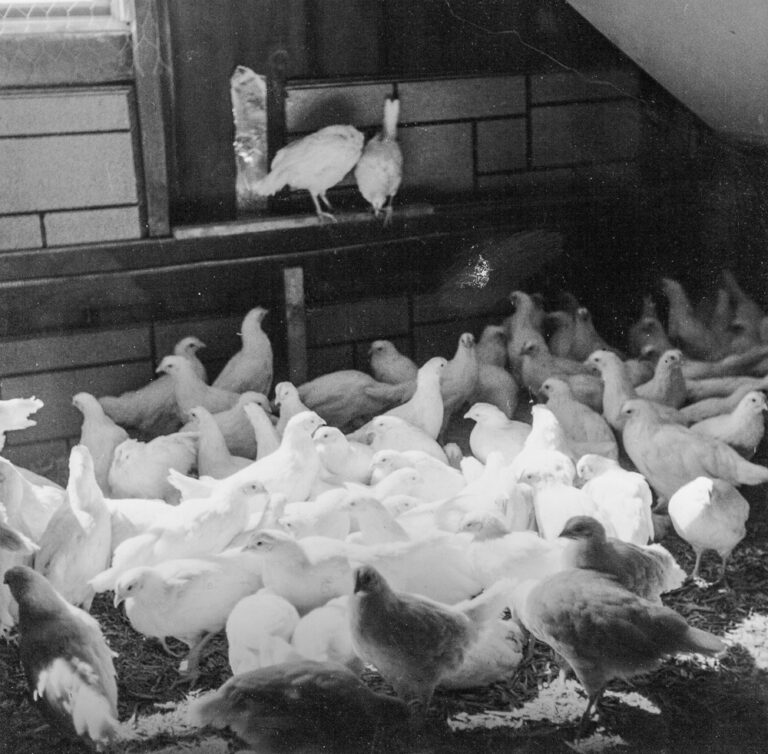
The first thing that comes to me when I think about my parents – in this case I mean mostly my father – they were wonderfully naive to think that the farm could succeed. My father had read some idyllic books about back-the-land efforts long before the hippie movement tried it again.
And on top of thinking that the farm would make money, he also thought that he could then quit his city job and have time to write, to become the writer he always wanted to be.
Remarkably, his parents had given him a full year away from work or college to write and he got some science fiction and some mystery short stories published. I have some of them. They were generally not good; he was ok working with words, but he didn’t dig deep in terms of emotions. Back to the chicken farm.
My mother later said that she didn’t want anything to do with chickens and my father talked her into it, saying how “someone” would come and take the eggs and it would all just be great.
In fact, after Dad and big brother Fred converted the old barn into two full floors for chickens, with a thick layer of chicken litter, hen houses built from wood and masonite, and installing water feeders, and infrared lamps for cold weather… then it turned out that my mother was the actual egg farm lady.
She, with tiny help from 5 or 6 year old me, gathered the eggs every day. Chickens really do lay an egg nearly every day, it’s a miracle, and one can see why an egg farm looks like a good thing.
We had a marvelous machine in the cellar under the house: an egg “candling” and sorting machine. It was nearly a Rube Goldberg device where each egg, after it rolled over a bright light where we looked for cracks and other defects, was then lifted by gentle mechanical hands from one tiny seesaw to the next, until the egg arrived at a seesaw where it was heavy enough to tilt and roll the egg into a sorting bin.
My father had bought nifty cardboard egg cartons labeled Feather Hill Farm. We put the eggs into the cartons, smalls, mediums, larges, and maybe even extra larges.
So there we were with lots of eggs to sell. With about 2,000 chickens, that is nearly 2,000 eggs a day, 167 dozen. My parents went to the nearby stores to sell these marvelous eggs but learned that the stores would not pay enough to make things work. The only way we could sell the eggs and make a nickel was for my mother to drive around town in one of our rickety old cars (was it the WWII jeep? Was it the 37 Chevy?)
As a kid I thought it was fun driving around selling eggs with Mom, but she told me years later that she hated it; she felt like a peasant woman.
As it turns out, there was already an egg farm in Mahopac, but a “real” one, run the the father of a classmate of mine. I remember the father explaining to my father that you had to have at least a quarter of a million chickens in order to buy feed in huge quantities that made it affordable. And this fellow, Murray, had nearly that many chickens in long barns, with feed and water coming in, and poop going out on conveyer belts.
This was modern egg farming and even Murray struggled against the really giant farms that had millions of chickens.
Keep in mind that our chickens were what would be called free range today and the eggs worth a premium, but in 1956 there was no such thing as a market for eggs raised by hens running around like hens, rather than squeezed 3 into a cage.
So in a few years my parents gave up on the egg farm fantasy. We always had some chickens running around loose (plus some ducks) so we had enough eggs for our own use.
By the way, there is a whole book and a movie about the Jewish Chicken Farmers of Petaluma, California. A bunch of them showed up in the early 1900s and they did well for decades, but none of that remains.
I can remember my mother wandering out, grabbing a chicken by the feet, laying it on the stump near the kitchen, and chopping off its head with an axe in one hand, chicken in the other. I watched her rip off the feathers and butcher the bird, many times. And that might have inured me to the butcher, but it never did. I stopped wanting to eat chicken for some years.
And worse, I saw inside the chicken all of the eggs that were getting ready to be laid: you can’t lay an egg a day without a whole assembly line growing them inside. And the site of all those latent eggs, covered with blood vessels, also turned my stomach and for some years I had a hard time eating eggs; the vision of masses of egglets, like a bunch of horrid grapes, covered with blood and veins haunted me for years.
One time we came back from a trip somewhere and found that the watering system had jammed and flooded the chicken barn with water. There are few things that smell worse than wet chicken litter, so we lived with that for a long time.
It occurs to me to wonder if we ever scooped up the top layer of chicken litter and threw it out, but I never did that, though my brothers, father, or mother might have.
Many years later my father and I put on cloth masks and set about shoveling all of the old old chicken litter out the little barn windows so we could use the barn for other things, mostly storage.
Which reminds me that the father that oldest brother Fred knew, nine years before me, was a different guy. Back then he was full of energy and crazy ideas, like having a farm. By the time I was older Dad has given up on nearly all of his dreams and instead was actually for once making a good living with the magazine he now published, until that happy outcome was taken away, another and a very sad chapter.